
Exhibit 001: Growth Bankruptcies
Key Findings:
More than 3,700 U.S. IPOs were analyzed to compare long-term investment outcomes.
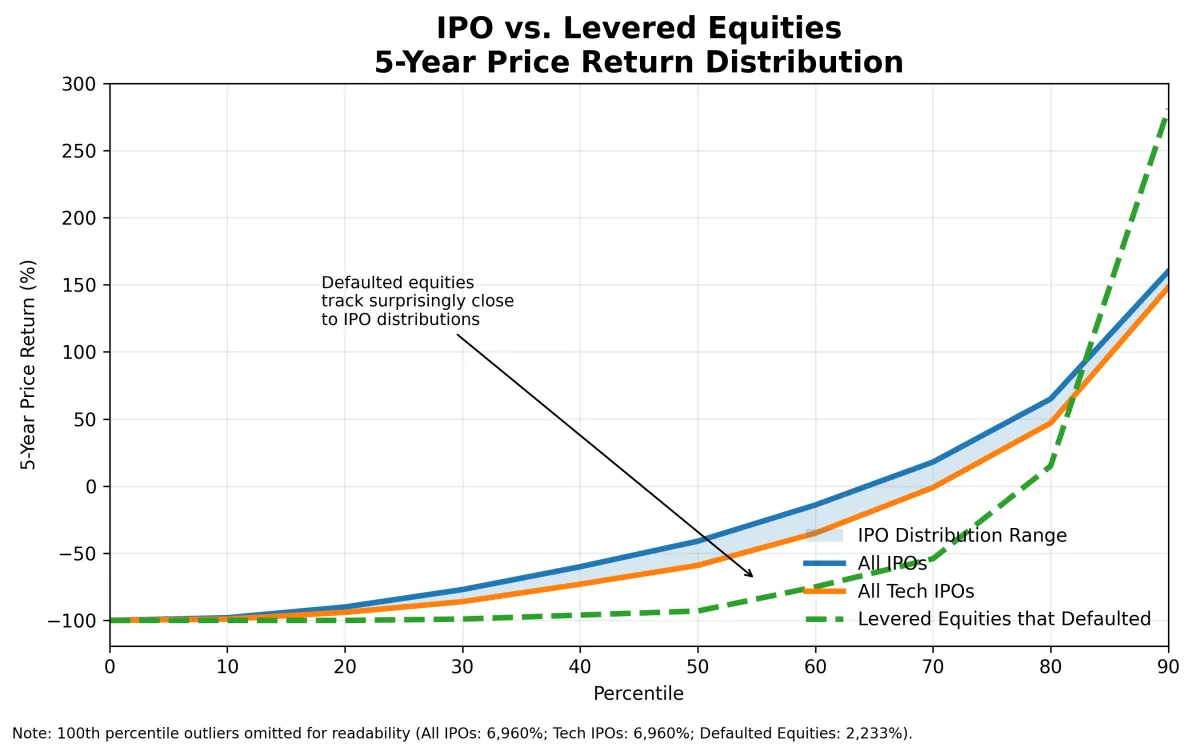
The median IPO lost 41% of its value over five years, while nearly one out of every three or four IPOs lost 75% or more of investors' capital.
Technology IPOs performed even worse, with investors typically losing 60–70% of their investment half the time, and 90% or more nearly one-quarter of the time.
The five-year return distribution of IPOs closely resembled that of companies that actually defaulted on their debt, despite the common perception that indebted firms represent the greater investment risk.
The authors estimate that a diversified portfolio would require an 85% cumulative default rate before leveraged equities would exhibit investment outcomes as poor as today's technology IPOs.
Overview
Conventional wisdom suggests that mature companies carrying significant debt are inherently riskier investments than newly public, high-growth businesses. Verdad tested that assumption by examining the long-term performance of more than 3,700 U.S. IPOs alongside companies that ultimately defaulted on their debt.
The results challenge that conventional view. Rather than producing superior long-term returns, the typical IPO generated substantial losses, while many of the most celebrated technology offerings produced outcomes comparable to companies experiencing severe financial distress. The study argues that investors often underestimate the risks associated with highly anticipated growth opportunities and overestimate the risks associated with mature, leveraged businesses.
Discussion
One of the study's most surprising findings is not simply that many IPOs perform poorly, but that their long-term return distributions closely resemble those of companies that actually defaulted on their debt. The implication is that investor optimism and elevated expectations can create risks every bit as significant as financial leverage. Companies don't necessarily have to enter bankruptcy to destroy shareholder value; excessive expectations alone can produce substantial capital losses.
For executives responsible for launching new products, entering new markets, pursuing acquisitions, or funding innovation, the lesson extends well beyond public markets. Growth initiatives are frequently evaluated on their promise rather than their underlying economics. This research serves as a reminder that enthusiasm, compelling narratives, and high expectations are not substitutes for disciplined evaluation and sound strategic architecture.
Why This Matters
Business initiatives are often judged by their ambition rather than their probability of success. This research demonstrates that markets routinely overestimate the value of exciting growth stories while underestimating the likelihood of catastrophic outcomes. It reinforces the importance of evaluating opportunities on evidence, structure, and execution - not optimism alone.
